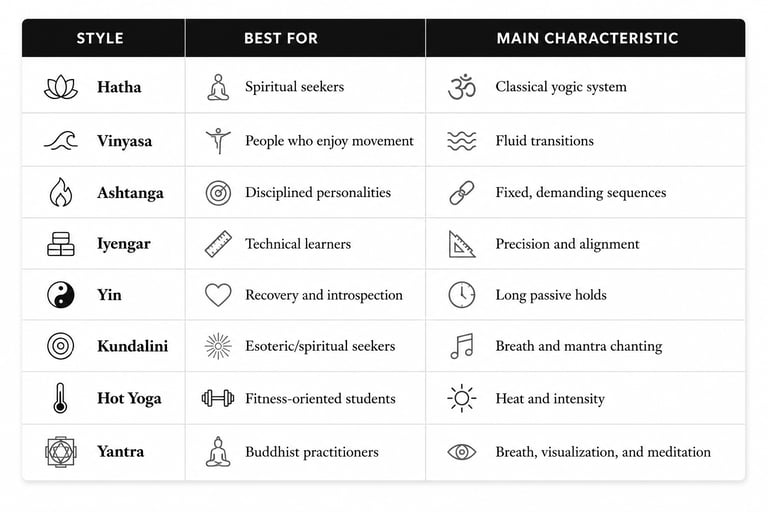
There is a version of yoga that will leave you drenched in sweat, legs trembling beneath you. Another will ask you to lie still on the floor for twenty minutes and simply breathe. Both of these are called yoga.
Across millennia, Yoga has been a philosophy, a medical system, a spiritual practice, a form of asceticism, and, more recently, a global fitness industry. Different styles inherited different parts of that history.
This article is a humble attempt to make those distinctions clearer.
Note: The styles below are all posture-based systems, the kind of yoga most people encounter in classes and studios around the world. Other branches, like Bhakti Yoga (the path of devotion), Raja Yoga (meditation-focused practice), or Yoga Nidra, are left aside here.
1. Hatha Yoga
The foundation
Hatha Yoga is the foundation most modern yoga styles grew from. It is a category to which many styles and schools belong.
That's why a Hatha class can vary enormously depending on the teacher. Most studios teach a more modern, posture-oriented form of Hatha. However, in a more traditional Hatha class, here's what you can usually expect:
- Mantras
- Pranayama (breathing practices)
- Asanas (postures) held for longer periods
- Extended relaxation at the end
- Meditation or seated stillness
- No music
There is a misconception that Hatha means easy, or that it's a beginner's class. That's not true. Hatha can be quite hardcore. Especially when you hold certain poses for three minutes or more.
Origins
The word Hatha can be broken down into two syllables: ha (sun) and tha (moon). The practice is understood as the balancing of opposing forces: effort and ease, heat and cool, yin and yang.
The foundational text is the Hatha Yoga Pradipika, written in the 15th century by a yogi named Swami Swatmarama. It describes postures, breathing techniques, mudras (hand gestures and energetic seals), and bandhas (internal muscular locks).
According to the text, Hatha Yoga is a preparation for the body and mind for longer periods of seated meditation. Classical Hatha was never about a strong core or improved flexibility, though those things happen. It was about making the nervous system stable enough to sit still.
Who it works well for
Spiritually inclined students looking to learn the most classical form of yoga. People who don't mind stillness, chanting, and silence.
2. Vinyasa Yoga
Water and flow
Unlike Hatha, Vinyasa is dynamic with constant transitions between postures. The body is meant to move like water, flowing from posture to posture. That's why classes are often advertised as Vinyasa Flow.
One of its great strengths is variety. A Vinyasa teacher can construct a class around any theme (hip openers, backbends, core stability, inversions) and the format accommodates all of it.
The sequencing logic, when a teacher is thoughtful, follows a healthy rhythm: warm the body methodically, build toward a peak posture or group of postures, then descend slowly into the nervous system with cooling poses and a proper final relaxation.
The focus is more on transitions than the individual postures. The meditative component of Vinyasa is kinetic: you find stillness not by stopping but by moving with full attention.
Origins
Vinyasa as a distinct modern style grew out of Ashtanga, which we'll discuss below. Teachers who trained in Ashtanga but wanted more creative freedom began sequencing their own classes, keeping the Ujjayi breath (covered in detail below) and the physical intensity while departing from the fixed series. By the 1990s, teachers like Shiva Rea and others had helped develop what we now call Vinyasa into its own recognizable form.
Who it works well for
Students who enjoy movement-based practice, and anyone who responds well to music and rhythm.
3. Ashtanga Yoga
Fire and discipline
If Vinyasa represents water, Ashtanga is its opposite: fire.
This style is extremely physically demanding and rigid. It consists of a fixed sequence of postures: six series in total, though most practitioners spend years in the Primary Series alone.
The Primary Series is called Yoga Chikitsa, meaning yoga therapy, and it is built around forward folds, hip openers, and twists. The sequence begins with ten sun salutations (five of each type), moves through a standing sequence, then a seated sequence, then closing postures.
The system is built on tristhana, three points of attention that must be maintained simultaneously: posture, drishti (a fixed gaze point for each posture), and Ujjayi.
The Ujjayi, also known as “Victorious Breath", is a foundational yogic breathing technique. It’s performed by slightly constricting the back of the throat, this creating an audible, soothing sound.
The practice also incorporates the three bandhas: mula bandha (engagement at the pelvic floor), uddiyana bandha (sucking in the lower abdomen), and jalandhara bandha (chin lock).
Traditional Ashtanga is taught in a Mysore format, in which everyone practices independently at their own pace. The teacher’s role is not to conduct the class, but to adjust students when needed and guide their progression. There is no music nor instructions.
Origins
The system was created by Sri K. Pattabhi Jois. Jois claimed to have learned it from his teacher, T. Krishnamacharya, the grandfather of modern yoga.
He claimed the style was based on an ancient manuscript called the Yoga Korunta, a document that no one has ever been able to locate and that most scholars believe either no longer exists or may have never existed in the form described.
Who it works well for
Students seeking a rigorous physical and contemplative practice, who do not mind practicing the same fixed sequence repeatedly, and who are willing to commit deeply to long-term refinement.
Note: Beware that movement is like nutrition: the more diverse, the better. Doing the same sequence over and over it’s not bad, but it should be supplemented with other movements/practices to prevent injury.
4. Iyengar Yoga
Precision and alignment
If I had to describe the Iyengar style nonchalantly , I'd call it yoga for nerds.
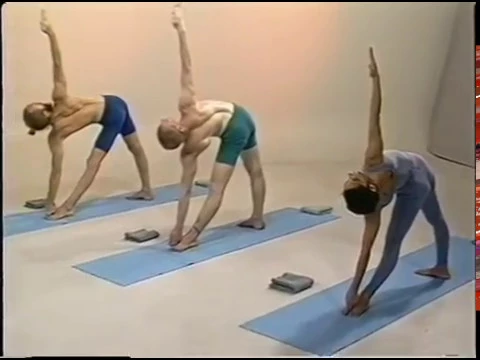
This style can be characterized by an obsessive precision in the construction and alignment of asanas. The other thing that sets it apart is the masterful use of props, to the point where the practice starts to resemble physical therapy (Iyengar Medical Classes are a thing).
The props (blocks, blankets, bolsters, straps, chairs, ropes) are tools for accessing the full expression of a posture regardless of the body's current limitations, and for developing the sensitivity to feel what correct alignment actually is.
Longer holds are central to the method. In that time, the teacher is looking at something very specific: the rotation of a femur, the lift of an inner ankle, the extension through the collarbones, the alignment of the spine.
Iyengar teachers are masters of adjustment, both hands-on and verbal. The vocabulary can take some getting used to: it's detailed in the way an anatomy lesson is detailed, and the directives come fast (examples: "Lift your inner kneecap"; "Roll the outer hip down"; "Extend the little-toe side of the foot").
For many people, a first Iyengar class is humbling in a particular way. If you come from another style, you may find that postures you thought you knew are poorly understood. Spending twenty minutes on Tadasana (just standing upright) will reveal subtle and previously unseen details about your body and how it stands.
Origins
B.K.S. Iyengar was probably the most influential single figure in the transmission of yoga to the Western world. He was also one of the last OG yogis to come directly out of India, having trained under the legendary Krishnamacharya.
His 1966 book Light on Yoga served as a reference text for teachers and practitioners for decades. It contains photographs of him demonstrating 200 postures with incredible precision and ease.of teaching. He was, by most accounts, a formidably demanding teacher (some would say military in his approach) and many Iyengar teachers carry that same intensity into their classes.
Iyengar developed his approach partly out of necessity. As a young man he was sickly (tuberculosis, typhoid, malaria) and he used asana practice as a way to rebuild his body from the inside out.
This gave him an unusually empirical relationship to the practice. He was interested in what postures actually did to the body, what precise alignment made them work, and what happened when alignment was wrong. He documented this obsessively.
Who it works well for
Students recovering from injury and those drawn to deep anatomical understanding of the practice. If the idea of asana mastery appeals to you, and you don't mind a practice that sacrifices flow for precision, Iyengar might be exactly what you're looking for.
5. Yin Yoga
Relaxation and recovery
Yin Yoga was not originally designed for yogis, as early students of this method were mostly stiff, muscle-bound martial artists. The style was designed for people doing intensely yang training: explosive, muscular, high-output. Yin Yoga counteracts those practices through passivity and a receptive approach to sensation.
The emphasis is not on muscular effort or constant movement, but on surrender and sustained awareness. Postures are held for three to seven minutes, sometimes longer, and are mostly floor-based. The focus is not so much on performing the posture in a standardized way, but on stressing the targeted tissues appropriately, which may look different depending on the body type.
The instruction is simple: go deep enough to feel it (but not so deep it hurts), relax everything around it, and stay.
With nothing to do but remain still, the mind can become loud very quickly. Boredom may arrive with unusual force. Old emotions may surface. This is true for Yin and any other style where long holds are present.
Origins
The system began with Paulie Zink, a martial arts champion and Taoist yoga practitioner who started teaching in the late 1970s. Zink called his practice Taoist Yoga, and it was always both yin and yang: stillness and movement together. What we now call Yin Yoga is only the first, beginner-level layer of his complete system.
The practice as most people know it today was shaped largely by Paul Grilley, one of Zink's students. Grilley began offering all-yin classes to his own Hatha students, which became popular and motivated him to develop the practice further. He built an academic curriculum around anatomy, his own philosophy, and research on the meridian system from Traditional Chinese Medicine. He called it Taoist Yoga, the same name Zink used.
It was Sarah Powers who coined the term "Yin Yoga," pointing out that the postures they were offering were primarily yin, not equally yin and yang. Together, Grilley and Powers popularized it across North America and Europe. That version (stripped of the yang movements, focused entirely on stillness and long holds) is what spread through studios worldwide and what most people practice today.
Who it works well for
Practitioners of more dynamic yoga styles or other high-intensity training methods who need a balancing counterpoint; and people dealing with chronically tight hips, lower back discomfort, or limited spinal mobility.
6. Kundalini Yoga
Powerful and esoteric
Kundalini Yoga is the most unusual practice in this list. It shares little with the other styles, with its closest relative being Yantra Yoga, which we'll cover below.
It is highly breath-centered, far less fitness-oriented, and more inward-facing than other yoga systems. Much of the class is spent seated on the floor with the eyes closed, directing attention toward breath, sensation, sound, and internal states rather than external form.
The practice is structured around kriyas, specific sequences that combine posture, breathwork, movement, sound, and meditation. Each kriya is designed to produce a defined effect, and there are thousands of them. A teacher selects a kriya appropriate to the class theme, be it clearing the liver, strengthening the nervous system, or opening the heart center.
Due to its more esoteric nature, Kundalini tends to have less mainstream appeal than other yoga styles. But for many who practice it, it becomes the most important practice of their lives.
Many Kundalini practitioners, usually seen wearing traditional white clothes and turbans, will tell you their tradition is the “real yoga”, and that kriyas are three times as powerful as conventional asanas. While that claim is highly disputed, it cannot be denied that Kriyas are transformative and powerful, having a strong effect on the nervous system and inducing altered states of consciousness.
The movement is often repetitive and rhythmic in a way that feels almost ritualistic. You might pump your navel center rapidly for several minutes using Breath of Fire, or hold an arm at a 60-degree angle for three minutes while chanting.
The duration is deliberate. Kundalini speaks of the three-minute threshold, the eleven-minute threshold, the thirty-one-minute threshold. These are specific timeframes at which physiological and energetic changes are said to occur.
Also, music plays a far more central role in Kundalini than in most other yoga styles, which is partly why this tradition has produced so many respected devotional musicians. Mantras, often in Gurmukhi (the script used in the Sikh scriptures), are sung or chanted throughout the class.
Origins
The form of Kundalini Yoga most widely practiced in the West was brought there by Yogi Bhajan (born Harbhajan Singh Khalsa) in 1969. He arrived in Los Angeles, began teaching in counterculture communities, and over the following decades built a large organization (3HO) and a system of practice that he claimed had been transmitted to him secretly through ancient Sikh and Tantric yogic traditions of Punjab.
This claim has been seriously disputed. Scholars argue that rather than an ancient secret tradition, Kundalini Yoga as Yogi Bhajan taught it was largely a bricolage he constructed himself, drawing primarily from two figures: a Hatha yoga teacher named Swami Dhirendra Brahmachari and the Sikh sant Maharaj Virsa Singh.
Who it works well for
Students drawn to a more esoteric practice where philosophy, breath, sound, and movement combine to alter consciousness. People dealing with anxiety, addiction, or chronic stress who want a practice oriented explicitly toward nervous system regulation. Those who are comfortable with a more esoteric and less fitness oriented framework.
7. Bikram/Hot Yoga
Heat and sweat
Bikram Yoga was, for several decades, one of the most commercially successful yoga systems in the world. The practice comprises twenty-six postures and two breathing exercises, and takes place in a room heated to 40°C (105°F) with 40% humidity.
Due to the controversies surrounding its founder, Bikram Choudhury, many studios previously operating under the Bikram name have since rebranded to "hot yoga", with some still teaching the same sequence.
The 26-posture sequence is methodical. It begins with Pranayama (a specific standing breath exercise) and works systematically through standing balance postures, spine strengthening postures, and finishing postures on the floor. The sequence has an internal logic that works the spine from every direction and trains balance, core stability, and cardiovascular endurance simultaneously.
The heated room makes tissue more pliable, allowing the body a deeper range of motion. It induces sweating at a rate that most people find either exhilarating or unpleasant, often within the first ten minutes, and places significant cardiovascular demand on the body. The discomfort from the heat also creates a psychological experience that forces you to be present. It takes up so much of your attention it's hard to think of anything else.
Origins
Bikram Choudhury developed the sequence in the 1970s, drawing on his background as an Indian yoga champion and later his time training with Bishnu Ghosh in Calcutta. He moved to the United States, opened studios in Beverly Hills, attracted celebrity clientele, became extraordinarily wealthy, and built a global franchise.
Sadly, Bikram is yet another prominent yoga guru accused of sexual abuse and misconduct. He fled the United States in 2017 after a civil judgment against him. If you are interested to know more, there is a good documentary film (Bikram: Yogi, Guru, Predator) that explains everything.
Who it works well for
Students who want a more fitness-oriented style with little to no philosophy. The heated room will help you sweat, burn extra calories, and increase your mobility.
Note: Heat can create a misleading sense of flexibility. Tissues that feel open at 40 degrees may not be in the same state at room temperature, and countless practitioners who mistake heat-induced range of motion for actual structural change end up overstretching and injuring themselves.
8. Yantra Yoga
The Yoga from Tibet
This is the most obscure practice on this list. There are very few qualified teachers and even fewer studios. It earns its place here not by popularity, but by what it actually is: a complete yogic system with a documented lineage stretching back to 8th-century Tibet.
Yantra is a Sanskrit word meaning sacred geometric diagram, the kind found in mandalas. In the Tibetan context, however, it carries a second meaning: movement of the body. A yantra in this practice is the form the body moves through, a structured sequence that carries prana through the energy channels.
A session does not begin with movement. It begins with the Nine Purification Breathings, described in the original text as "eliminating the impure air nine times." After that come preliminary warm-up exercises called tsijong: joint-loosening movements focused on the limbs, using more vigorous breath to prepare the body.
Then come the Eight Movements, called lungsang ("purifying the prana"). Each movement trains a specific quality of breath: the varying speeds at which air enters and leaves the body, and different types of retention in between.
After the Eight Movements come the five groups of yantras themselves: 108 movements in total, organized into five series, each paired with a specific breathing technique. Many of the physical positions are recognizable to anyone with a Hatha background.
Most of the yantras are done on the ground (seated in lotus or half-lotus, kneeling, lying) because the system is explicitly designed to support and deepen seated meditation rather than replace it. Another distinct feature is that practitioners are instructed to hold the breath while inside the posture itself. You enter the posture already holding the air, remain still, and only release once the count is complete.
Visualization is also woven throughout the practice in a way that sets it apart from most other yogic systems. While some Hatha pranayama traditions include visualization, it is far more central here.
Origins
The philosophical ground of Yantra Yoga is Dzogchen, the "Great Perfection," the highest teaching in the Nyingma school of Tibetan Buddhism.
Its root text, the Nyida Khajor ("The Union of Sun and Moon"), was orally transmitted in Tibet in the 8th century by the great master Padmasambhava to the Tibetan translator and Dzogchen master Vairochana.
Vairochana was one of the most important early figures in Tibetan Buddhism, responsible for translating most of the original Dzogchen texts from the language of Oddiyana into Tibetan. He received the Yantra Yoga transmission directly, taught it to his students, and the lineage has continued unbroken since.
It was brought to the West by Chögyal Namkhai Norbu, a Dzogchen master born in eastern Tibet in 1938, who began transmitting the practice in the 1970s and later published it in his 2008 book Yantra Yoga: The Tibetan Yoga of Movement.
Who it works well for
This style is most relevant for practitioners of Buddhist meditation seeking a moving practice that serves and deepens their sitting. It will also speak to those drawn to Tibetan culture specifically, and to practitioners who are looking for a contemplative practice with philosophical depth and strong emphasis on pranayama.
A final note
Hope this guide gave you a clearer picture of what's out there. If it helps you find a style that fits, or simply makes you more curious about trying something new, it did its job.
One thing worth saying: reading about yoga only goes so far. One class will tell you more than any guide. And when you do try, remember that the teacher matters as much as the style: a great teacher is worth learning from, even if the tradition they teach wasn't your first choice.